
科目: 來(lái)源:人教新課標(biāo)初三上冊(cè)練習(xí) 人教新課標(biāo) 題型:050
閱讀理解
“Why can birds fly? Even a fly can fly. Why should these small living things have wings and be able to fly but we men can't?”
The man who was asking the questions didn't look like a teacher. His students weren't in a classroom. They were standing outdoors listening to him talk. But he was a teacher, a very great teacher. His name was Socrates. He lived in the Greek city of Athens (希臘雅典) long, long ago. He wore old woolen clothes. He never wore shoes no matter how rainy or cold the weather was. He knew all the famous writers and leaders in Athens. But he never wanted to be famous or rich himself. He just wanted to think and talk about his ideas.
Some people said that Socrates thought so much and so hard about the world that he sometimes would stand alone for many hours just thinking, not moving or speaking a word.
Socrates' students were eager to learn from him. But because he spoke out when someone' s opinion was wrong, some of the leaders in Athens became so angry that they arrested (逮捕) Socrates and put him into prison (監(jiān)獄).
But Socrates refused to stop talking. He chose to die rather than give up teaching what he believed to be true.
(1) What did Socrates think about?
[ ]
A. He wanted to be a famous writer
B. He wanted to be a leader.
C. He wanted to be rich.
D. He thought about the truth.
(2) Why did some leaders hate Socrates? Because ________.
[ ]
A. he never wore shoes
B. his ideas were wrong
C. he didn't agree to some leaders' opinion
D. he often said something wrong
(3) Socrates ________ when he was arrested.
[ ]
(4) Which of the following is true?
[ ]
A. Socrates often felt lonely.
B. Socrates just wanted to speak out his mind.
C. Socrates was always angry with the rich.
D. Socrates thought birds should not have wings but we men should.
(5) Which of the following is the best title of the passage?
[ ]
查看答案和解析>>
科目: 來(lái)源:人教新課標(biāo)初三上冊(cè)練習(xí) 人教新課標(biāo) 題型:050
閱讀理解
Americans with small families own a small car or a large one. If both parents are working, they usually have two cars. When the family is large, one of the cars is sold and they will buy a van (住房汽車(chē)).
A small car can hold(容納)four persons and a large car can hold six persons but it is very crowded. A van holds seven persons easily, so a family with three children can ask their grandparents to travel together.
Mr. King and his wife had a third child last year. This made them sell a second ear and buy a van. There are seven seats in the van, and two of them are used to put things on, for a family of five must carry many suitcases when they travel. When they arrive at their grandparents' home, the suitcases are put into the two seats. And then they can carry their grandparents.
Americans call vans motor homes. A motor home is always used for holidays. When families are traveling to the mountains or to the seaside, they can live in their motor home for a few days or weeks. All the members of a big family can enjoy a happier life when they are traveling together. That is why motor homes have become very popular. In America there are many parks for motor homes.
(1) From the passage we can learn that a big American family usually ________.
[ ]
(2) After Mr. King and his wife had a third child, first they ________.
[ ]
A. bought a van
B. sold one of their old cars
C. moved to their grandparents' house
D. got many suitcases
(3) A motor home is usually owned by a big family with ________.
[ ]
(4) The last sentence“In America there are many parks for motor homes.”in this passage means“ ________.”
[ ]
A. American families like to visit parks
B. There are many beautiful parks in America
C. Vans can be parked in many places in America
D. Motor homes can be bought in many places in America
(5) Americans usually drive motor homes to_______.
[ ]
A. visit their grandparents at weekends
B. take their children to school every day
C. travel with their family members for a holiday
D. do some shopping with their family members
查看答案和解析>>
科目: 來(lái)源:人教新課標(biāo)初三上冊(cè)練習(xí) 人教新課標(biāo) 題型:050
閱讀理解
My respecting teacher
I always thought that a man who was wise (睿智的) and good would become rich, but this year I have learned that this is not always true. I learned this from my teacher. He is both wise and good, but is not rich at all, for being a teacher, he doesn't have a good income. He may be able to get more money if he gives up teaching for business. But he is so proud of being a teacher that he takes pleasure in helping young people. He stays at school from morning till late afternoon and works very hard. He always smiles at us when we go to ask him for help. He is kinder to us than anyone whom I've ever known. I think it must be easier to learn history or maths than to learn how to become such a man. He scolds (責(zé)備) us when we do something wrong, but it teaches us to try to do better. We all wish to study with him as long as possible, but that may be impossible. Some of us may become doctors, some be come businessmen, some become engineers, some become writers, but we all want one thing very much to become men like our teacher.
(1) The writer always thought that ________.
[ ]
A. a wise and good person would never become rich
B. a wise and good person would become rich
C. a wise teacher would become rich
D. a good teacher would never become rich at all
(2) The writer's teacher is the following except that ________.
[ ]
(3) What's the meaning of this sentence“He is kinder to us than anyone whom I've ever known.”?
[ ]
A. He is the kindest person I know.
B. He is kinder than many people I know.
C. I know many people who are kinder than he.
D. Only a few people are kinder than he.
(4) From this passage, we know that the writer ________.
[ ]
(5) Which is NOT TRUE according to (根據(jù)) this passage?
[ ]
A. The writer is proud of his teacher very much.
B. The writer may become a teacher in the future, too.
C. It's very easy to be a wise and good teacher.
D. The teacher may become rich if he gets down to business.
查看答案和解析>>
科目: 來(lái)源:人教新課標(biāo)初三上冊(cè)練習(xí) 人教新課標(biāo) 題型:050
閱讀理解
It is over a year now since Cathy came to China. She is now living in Nanjing and has worked in a computer factory for six months. The factory is in the north of the city, and her flat(公寓) is in the south. But, she has never been late for work.
Cathy is very popular in the factory. She is kind to everybody and gets on well with the Chinese workers. After work, in the evenings they visit each other and talk about almost everything.
However, Cathy has made up her mind to leave the factory. She is going to find a job in a travel service (旅行社) .“If I work in a travel service, I'll be able to meet more people. I can learn more about China,”she told her friends.
One day last week she had a talk with the manager of the travel service. He seemed pleased with her Chinese. At the end of the talk, he said,“I'll give you a ring in a week and tell you the result.”Now Cathy is waiting for the answer.
(1) Cathy has been in China for ________.
[ ]
(2) She is ________ for work.
[ ]
(3) Almost ________ in the factory knows Cathy.
[ ]
(4) She wants to work in ________ because she wants to know more about China and the Chinese people.
[ ]
(5) Cathy's ________ must be quite good.
[ ]
查看答案和解析>>
科目: 來(lái)源:人教新課標(biāo)初三上冊(cè)練習(xí) 人教新課標(biāo) 題型:050
閱讀理解
“Katy, get your books. It's time to go to school,”said Mum.
“But I don't like to,”Katy said.
“Well, go and have fun,”Mum told her.
When Katy got to school, some children asked her to play with them. She really wanted to, but she was too shy to say yes.
That night when Katy got home she wasn't happy, so she went straight to her room to play with her friend Jimmy the Tiger. She told Jimmy about her shyness and Jimmy told her,“Tomorrow at school, I will help you, and you will feel good about talking to other children.”
The next morning, after breakfast, she left home to catch a bus as usual, but this time with Jimmy. On the bus, Jimmy started telling Katy how he was going to help her to talk to other children. When the bus arrived at school, Katy jumped off and ran to her classroom to put her books away. Then she ran outside. But suddenly she stopped.
“I can't go over and ask to play with them!!!”
“Go !”said Jimmy.
As she was walking over to the children, a girl said to her,“Hey, Katy, do you want to play with us?”Katy said,“Yes, I would love to.”She was so happy. From that day on she loved going to school. And now she is happy to go to school alone, without Jimmy the Tiger.
(1) Katy usually went to school _______.
[ ]
(2) Katy did not like school at first because she was a ________ girl.
[ ]
(3) Katy's classmates asked her to ________ with them.
[ ]
(4) Who said“I can't go over and ask to play with them!”?
[ ]
(5) The story tells us ________
[ ]
A. Jimmy was a school boy
B. Katy went to school once a week
C. Jimmy helped Katy become confident
D. Katy's mum took her to school every day
查看答案和解析>>
科目: 來(lái)源:人教新課標(biāo)初三上冊(cè)練習(xí) 人教新課標(biāo) 題型:050
閱讀理解
Rebecca Stevens was the first British woman to climb Mount Qomolanga. Before she went up the highest mountain in the world, she was a journalist and lived in a small fiat (公寓) in South London.
In 1993, Rebecca left her job and her family and traveled to Asia with some other climbers. She found that life on Qomolangma is hard.“You must carry everything on your back,”she said,“so you can only take things that you will need. You can't wash on the mountain, and in the end I didn't even take a toothbrush. I am usually a clean person but there is no water, only snow, Water is very heavy so you only take enough to drink!”
When Rebecca reached the top of Mount Qomolangma on May 17,1993, it was the best moment of her life. Suddenly she be came famous.
Now she has written a book about the trip and people often ask her to talk about it. She has a new job too, on a science programme on television.
Rebecca is well known today and she has more money, but she still lives in the little flat in South London among her pictures and books about mountains!
(1) Before Rebecca climbed Qomolangma, she worked as a ________
[ ]
(2) Rebecca went to Asia to ________ in 1993.
[ ]
A. spend a holiday with her family
B. climb the highest mountain
C. look for a new job
D. take some pictures
(3) Rebecca found life on Qomolangma is hard because ________.
[ ]
A. she is usually a very clean person
B. she has nothing but a toothbrush
C. water there is very heavy and expensive
D. everything that is needed has to be carried on the back
(4) After her trip to Asia, Rebecca ________
[ ]
(5) Rebecca became famous for ________
[ ]
A. her science programme
B. her pictures and books
C. having much money
D. reaching the top of Mount Qomolangma
查看答案和解析>>
科目: 來(lái)源:人教新課標(biāo)初三上冊(cè)練習(xí) 人教新課標(biāo) 題型:050
閱讀理解
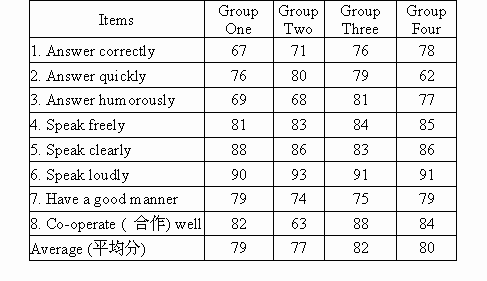
Here is a mark table (分?jǐn)?shù)表) about the students' English competition (競(jìng)賽) . Find some useful information to the following questions.
(1) ________ is the most humorous of all the four groups.
[ ]
(2) Group Two is thought to have spoken as ________ as Group Four.
[ ]
(3) Group Two did worst in ________
[ ]
(4) In“Answer correctly”, Group Three got ________ more marks than Group One.
(5) According to the table, which of the following is NOT true?
[ ]
A. Group Three is the winner of the competition.
B. Group One did as well as Group Four in“Answer quickly”.
C. All groups did best in“Speak loudly”of all the items.
D. The average of Group Two is 5 marks less than that of Group Three.
查看答案和解析>>
科目: 來(lái)源:人教新課標(biāo)初三上冊(cè)練習(xí) 人教新課標(biāo) 題型:050
閱讀理解
Albert Selmer, a German businessman who speaks good English, was surprised during his latest trip to Beijing. When he got into a taxi, the driver greeted him and asked where he would like to go-in English!
“This couldn't be imagined eight years ago when I first visited Beijing,” said Selmer. He wouldn't be so surprised when he knew so many people were learning English in this city.
Beijing failed in its bid (申辦) for the 2000 Games. One of the reasons was that foreigners found it hard to communicate (交流) with Beijing citizens (市民) . Most of them spoke only Chinese.
Today the city is working to improve communication.
One great change has happened during Beijing' s preparations (準(zhǔn)備) . Now Beijing citizens are looking forward to the 2008 Games by actively learning English. Free classes opened in a number of Beijing universities are enjoying high attendance (出席) . Citizens are taught useful expressions, greetings how to give directions and how to introduce themselves.
Shop assistants, bus and taxi drivers and even policemen are learning English to welcome the 2008 Olympic Games. The young taxi driver who surprised the German visitor is probably one of those learners. The first-stage aim (目標(biāo)) of the “Beijing Citizens' English Speaking Plan” started by the city government in August, 2002, is to popularize (普及) English among the government officers, taxi drivers, hotel staff and shop assistants. In five years the percentage (比例) of Beijing citizens who can speak English will be raised to around 30 percent from 15 percent now.
(1) Albert Selmer was surprised when he got into the taxi, because ________.
[ ]
A. he found the driver served him hotter
B. the car didn't look the same as it did eight years ago
C. the driver was very polite to him
D. the driver could speak English
(2) Today more and more Beijingers are learning English in order to ________
[ ]
A. support the bid for the 2008 Olympics
B. make English the official language in China
C. make themselves understood easily while talking to foreigners
D. cash up with the modem development
(3) From this passage we know that ________
[ ]
A. spoken-English is very important in our daily life
B. Albert Selmer often came to China these years
C. Beijingers are taking an active part in learning English
D. the main reason why Beijing failed in its bid for the 2000 Games was that very few people could speak English
(4) If more and more Beijingers can communicate with the foreigners in English, ________.
[ ]
A. they will learn more about the Olympic Games
B. it will help Beijing's 2008 Games
C. they will be treated strangely
D. they will be given a hand while in trouble
[ ]
(5) If the population of Beijing will be fifteen million in 2008, how many people will probably be able to speak English? --About ________.
[ ]
查看答案和解析>>
科目: 來(lái)源:人教新課標(biāo)初三上冊(cè)練習(xí) 人教新課標(biāo) 題型:050
閱讀理解
One morning in April, Jim Reed checked his e-mail. It was from a woman in Pittsburgh, Pennsylvania. He had talked to her on e-mail many times in the last ten days. All the other messages were fun and interesting to read. This message was different.
The message said,“Good-bye loved kowihn yu I amj leavig.”
Mr. Reed was frightened by the message. He tried to understand the words that were not spelled tight. He quickly wrote a
message to his new friend.
“What do you mean by the message you just sent me?”
He waited but did not get an answer. He wrote back,“Please talk to me.”
Finally, she wrote,“I am fallllljg asleep what ti say gildgye ti ny friends.”Mr. Reed thought hard about this message.“Is she going to kill herself?”he thought.
“What is your phone number?” he typed. The woman sent a phone number. Mr. Reed called. At first the phone was busy.
Then it just rang and rang. He called the police in Pittsburgh, and told them his story. Then he faxed them what his friend wrote.
The police and paramedics (醫(yī)護(hù)人員) quickly went to the woman' s house. When she didn't answer the doorbell, they broke in. They found her on the floor near the computer. She told them,“I took 60 pills.”The paramedics rushed her to the hospital.
“Mr. Reed did a great job of saving this woman,”the police captain said.“If he hadn't guessed at the e-message, she would
be dead now.”The woman is fine now, and she thanks Mr. Reed for saving her life.
(1) Mr. Reed talked with the woman ________.
[ ]
(2) The e-message he found was strange because ________.
[ ]
A. it was fun to read
B. it was not interesting like usual ones
C. the woman wrote nothing.
D. the woman wrote it ten days ago
(3) As soon as Mr. Reed read the e-message, he ________.
[ ]
A. wrote back to ask her about the meaning of the message
B. called the police for help
C. went to save the woman himself
D. felt frightened and turned off the computer
(4) The woman wanted to ________
[ ]
(5) What's the best title (題目) of the passage?
[ ]
查看答案和解析>>
科目: 來(lái)源:人教新課標(biāo)初三上冊(cè)練習(xí) 人教新課標(biāo) 題型:050
閱讀理解
I was very disappointed (失望) not to be able to go to the jazz concert last Friday. The notice in the paper said that you could buy tickets at the theatre box office in Richland Hills any day between 10:30 a.m. and 3:00 p. m. Since I work from 9:00 a.m. to 5:00 p. m, the only time I could go to the theatre was during my 45-minute lunch break. Unluckily, the theatre is on the other side of the town, and the bus service (服務(wù)) between my office and Richland Hills is not very good. But if you are lucky, you can make the round trip in 45 minutes.
Last Monday, I stood at the bus stop for fifteen minutes waiting for the bus. By the time I saw one come around the comer, there was not enough time left to make the trip. So I gave up and went back to the office. The same thing happened on Tuesday, and again on Wednesday. On Thursday, my luck changed. I got on a bus right away. When I got there, however, I found a long line of people at the box office. I heard one man said he had been waiting in line for over an hour. I knew I would not have enough time to wait in line, I caught the next bus and went hack across the town. By Friday I decided to make the trip by taxi, it was expensive, but I felt the concert would be worth hearing. The trip by taxi only took 10 minutes, but it felt like an hour to me. When I got to the theatre, I was relieved to see that nobody was waiting in line. The reason, I quickly found, was that they had already sold all the tickets.
(1) The writer learned ________ that there would be a concert last Friday.
[ ]
(2) The writer tried to go to the theatre every day but successfully got there only ________.
[ ]
(3) If lucky, the writer could spend about ________ on the trip to the theatre from his office by bus.
[ ]
(4) Maybe the word “________” can be used instead of the underlined (劃線的) word “relieved”.
[ ]
(5) The writer mainly tells us he ________.
[ ]
A. enjoyed himself in the theatre
B. was angry at buying the ticket
C. had some trouble with the bus service
D. was sad at missing the concert
查看答案和解析>>
國(guó)際學(xué)校優(yōu)選 - 練習(xí)冊(cè)列表 - 試題列表
湖北省互聯(lián)網(wǎng)違法和不良信息舉報(bào)平臺(tái) | 網(wǎng)上有害信息舉報(bào)專(zhuān)區(qū) | 電信詐騙舉報(bào)專(zhuān)區(qū) | 涉歷史虛無(wú)主義有害信息舉報(bào)專(zhuān)區(qū) | 涉企侵權(quán)舉報(bào)專(zhuān)區(qū)
違法和不良信息舉報(bào)電話:027-86699610 舉報(bào)郵箱:58377363@163.com