
科目: 來(lái)源:不詳 題型:閱讀理解
查看答案和解析>>
科目: 來(lái)源:不詳 題型:閱讀理解
| A.Easter | B.Christmas | C.The Spring Festival | D.New Year’s Day |
| A.get a part-time job in the restaurants |
| B.go to the beach to have fun in the sunshine |
| C.fly back to their homeland to stay with their parents |
| D.go to school to study |
| A.Skiing on an iced lake |
| B.Hiking in the mountains |
| C.Studying in a school library |
| D.Going to the beach to enjoy the sunshine |
| A.a(chǎn)ll the foreign students in Australia will go home during Christmas |
| B.people in Australia usually go to see Easter Show in March. |
| C.it’s hard to find a part-time job at Christmas |
| D.Chinese students in an Australian school needn’t go to school when Spring Festival comes |
| A.Christmas time in Australia |
| B.The holidays in Australia |
| C.Enjoy your visit to Australia |
| D.Have you ever studied in Australia? |
查看答案和解析>>
科目: 來(lái)源:不詳 題型:完形填空
| 小題1: |
|
| 小題2: |
|
| 小題3: |
|
| 小題4: |
|
| 小題5: |
|
| 小題6: |
|
| 小題7: |
|
| 小題8: |
|
| 小題9: |
|
| 小題10: |
|
查看答案和解析>>
科目: 來(lái)源:不詳 題型:閱讀理解
| United Kingdom Celebrations for the Spring Festival in the UK started in 1980, with the first evening party held in 2002. Every new year, people get together and have a lot of activities. They sing songs, dance to music, share photos with friends or enjoy films in a cinema. |
| United States The Spring Festival has become a key time for Chinese living or working in the US. They join in a large evening party to welcome the traditional new year. It is a good chance for people to build a circle of friends and feel that they are not alone because they share the same culture and values. |
| Australia The Chinese new year will be welcomed with three weeks of celebrations across Australia. Many people come to Sydney’s Chinatown or Little Bourke in Melbourne. They enjoy fireworks, lion dances, dragon boat and many other traditional activities. The celebrations are also a bridge towards better understanding between Chinese and non-Chinese. |
| Singapore The family dinner on new year’s eve is an important tradition for Chinese whether they were born in Singapore or moved there from China. They place traditional food on a table as an act of remembering their past. Then the whole family enjoy their dinner together. They usually hold it at home because having it in a restaurant takes away the meaning of the tradition. |
| A.1890 | B.1980 | C.2000 | D.2002 |
| A.say hello to the traditional new year |
| B.refuse a good chance |
| C.tell others they are alone |
| D.share different cultures |
| A.fireworks | B.lion dances |
| C.trick or treat | D.dragon boat races |
| A.they want to keep Chinese tradition |
| B.the restaurant is far away |
| C.they moved there from other places |
| D.they were born in Singapore |
| A.a(chǎn)ll parts of the world celebrate the Spring Festival |
| B.the Chinese new year is celebrated only in China |
| C.celebrations for the Spring Festival are just held in four foreign countries |
| D.Chinese across the world have a strong feeling towards the Spring Festival |
查看答案和解析>>
科目: 來(lái)源:不詳 題型:閱讀理解
| A.how to eat out |
| B.where to eat out |
| C.what to eat out |
| D.who pays for the meal in different situation |
| A.去訂餐 | B.共同就餐 | C.去飯店 | D.各自付款 |
| A.he’s going to pay for your meal |
| B.he’s going to lend some money to you |
| C.he can’t understand you |
| D.he’ll be angry with you |
| A.a(chǎn)sk men to pay for their clothes |
| B.try to pay for their own meals |
| C.never have anything outside |
| D.try to pay for the men’s meals |
| A.the man will pay for it |
| B.the woman will pay for it |
| C.they will go Dutch |
| D.a(chǎn)nother person will pay for them |
查看答案和解析>>
科目: 來(lái)源:不詳 題型:閱讀理解
| A.noodles | B.dumplings | C.moon cakes | D.only vegetables |
| A.meat | B.seafood |
| C.vegetables and pork | D.vegetables |
| A.you have time | B.you are happy |
| C.you are busy | D.you are hungry |
| A.糖 | B.醬油 | C.辣椒 | D.醋 |
| A.They’ll feel unhappy. | B.They’ll be angry. |
| C.They’ll feel lucky. | D.They’ll be sad. |
查看答案和解析>>
科目: 來(lái)源:不詳 題型:完形填空
| 小題1: |
|
| 小題2: |
|
| 小題3: |
|
| 小題4: |
|
| 小題5: |
|
| 小題6: |
|
| 小題7: |
|
| 小題8: |
|
| 小題9: |
|
| 小題10: |
|
查看答案和解析>>
科目: 來(lái)源:不詳 題型:閱讀理解
| A.talk | B.stand |
| C.eat something | D.read papers |
| A.How do you do? | B.How are you? |
| C.Nice weather! | D.Nice to meet you! |
| A.you are friendly |
| B.you are right |
| C.you are English |
| D.you talk too much |
| A.English people like to talk on a bus. |
| B.English people don't like to talk about weather. |
| C.English people are not friendly at all. |
| D.In England,the weather often changes (變化). |
| A.hungry | B.happy |
| C.kind | D.worried |
查看答案和解析>>
科目: 來(lái)源:不詳 題型:閱讀理解
| A.in central Hangzhou | B.in eastern Hangzhou |
| C.in northern Hangzhou | D.in western Hangzhou |
| A.two | B.three | C.five | D.ten |
| A.first | B.second | C.third | D.fourth |
| A.students | B.teachers | C.singers | D.tourists |
查看答案和解析>>
科目: 來(lái)源:不詳 題型:閱讀理解
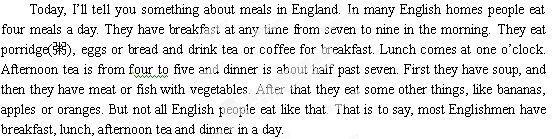
| A.tea and eggs | B.hamburgers and tea |
| C.coffee and salad | D.eggs and fish |
| A.a(chǎn)ny time | B.nine | C.five | D.one |
| A.from one to two | B.from two to three |
| C.from three to four | D.from four to five |
| A.bananas and apples | B.soup and meat |
| C.meat and fish | D.porridge |
查看答案和解析>>
國(guó)際學(xué)校優(yōu)選 - 練習(xí)冊(cè)列表 - 試題列表
湖北省互聯(lián)網(wǎng)違法和不良信息舉報(bào)平臺(tái) | 網(wǎng)上有害信息舉報(bào)專(zhuān)區(qū) | 電信詐騙舉報(bào)專(zhuān)區(qū) | 涉歷史虛無(wú)主義有害信息舉報(bào)專(zhuān)區(qū) | 涉企侵權(quán)舉報(bào)專(zhuān)區(qū)
違法和不良信息舉報(bào)電話:027-86699610 舉報(bào)郵箱:58377363@163.com