欧美日韩黄网欧美日韩日B片|二区无码视频网站|欧美AAAA小视频|久久99爱视频播放|日本久久成人免费视频|性交黄色毛片特黄色性交毛片|91久久伊人日韩插穴|国产三级A片电影网站|亚州无码成人激情视频|国产又黄又粗又猛又爽的

相關(guān)習(xí)題
 0  60825  60833  60839  60843  60849  60851  60855  60861  60863  60869  60875  60879  60881  60885  60891  60893  60899  60903  60905  60909  60911  60915  60917  60919  60920  60921  60923  60924  60925  60927  60929  60933  60935  60939  60941  60945  60951  60953  60959  60963  60965  60969  60975  60981  60983  60989  60993  60995  61001  61005  61011  61019  159627 

科目: 來(lái)源:不詳 題型:閱讀理解

任務(wù)型閱讀 閱讀下面短文,根據(jù)短文內(nèi)容,完成下列各題。(共5小題,計(jì)10分)
Language is always changing and developing. This isn’t a bad thing. If English hadn’t changed for a long time, we won’t have words to describe telephones, washing machines, computers or some other new things.
Language changes for several reasons. First, it changes because the needs of its speaker change. New technologies, new products, and new experiences need new words to express them clearly. Another reason for change is that different people have different language experiences. People use different sets of words and expressions, because they have different ages, jobs, education levels(水平) and so on.
How does language develop then? On the one hand, many of the languages changes begin with young people. When young people communicate with others of their own age, their language grows in grammar, words and expressions that are different from the older people’s. Some have a short lifetime but others can influence the language for long. On the other hand, we get new words in many different ways. We borrow them from other languages, we create them by making words shorter or combining words and we make them out of proper names.
Languages that don’t change over time are considered dead languages. The fact that English changes so much shows that it is alive and well.
小題1:What does the writer think of the change and development of language?
He thinks it is                       .
小題2:Why do people use different sets of words and expressions according to the passage?
Because their          and education levels are different.
小題3:How many reasons for language change are mentioned in this passage?
The writer mentions          reasons.
小題4:How do young people help develop language?
They do it when they                  others of their own age.
小題5: What is considered a dead language according to the passage?
The one that                   over time is considered a dead language.

查看答案和解析>>

科目: 來(lái)源:不詳 題型:閱讀理解

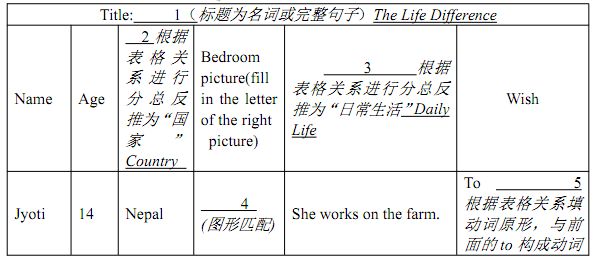
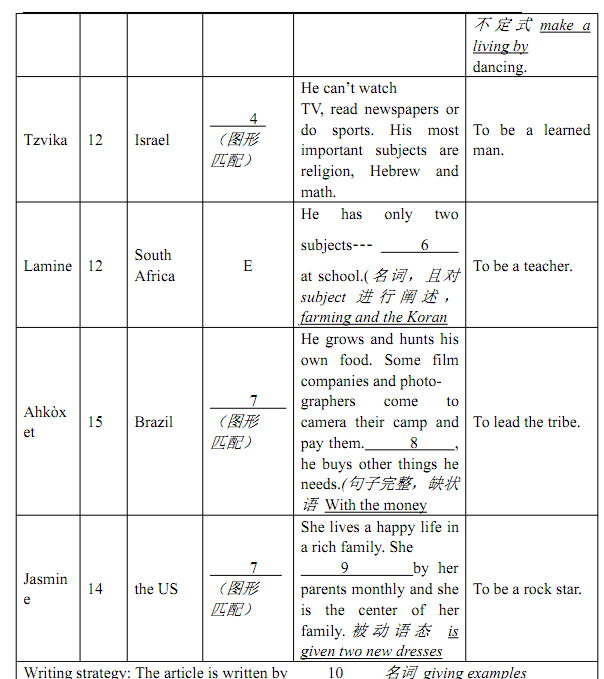
閱讀下面短文,根據(jù)其內(nèi)容,補(bǔ)全表格中所缺信息。請(qǐng)將答案按編號(hào)依次填入表格內(nèi)的題號(hào)后橫線上。 (共 10 小題,每小題 1 分:計(jì) 10分)
1、The life difference between east and west.rich and poor becomes clear when we look at how the kids sleep at night.
Jyoti, aged 14, Nepal Jyoti left school at a young age and now lives with one of her sisters in the Nepalese countryside where she works on the farm. 4、①The family sleep on mats on the mud floor in the open air, with an open fire for cooking and keeping warm. Jyoti loves dancing and 5、she wants to become a dancer to make money for her family.
Tzvika, aged 12,West Bank(約旦河西岸), Israel 4、②Tzvika lives in a gated community(社區(qū)) of 36,000 Orthodox Jews in an Israeli settlement( 定 居 點(diǎn) ) on the West Bank. Televisions and newspapers are not allowed from the settlement. The average family has nine children, but Tzvika has just two brothers, with whom he shares his room. Religion(宗教) is the most important subject, followed by Hebrew language and math. Sport is not allowed in the school. Tzvika wants to be a learned man when he grows up.
Lamine, aged 12, Bounk Village, South Africa Lamine studies at the local all- boy Koran school and shares a room with several other schoolmates. 6、His day starts at six o’clock when he and the other boys work on the school farm with the guide of teachers, and in the afternoon the boys study the Koran(可蘭經(jīng)). In his free time, lamine likes to play football with his friends and when he grows up he would like to teach in this school.
Ahk?xet, aged 15, River Amazon, Brazil 7、①Ahk?xet is a member of the Kraho tribe(部落) living near the river of Amazon. There are only 1,900 members of the tribe. All the tribe members grow and hunt their own food, and any other material 8、they need is bought, using money made from film companies and photographers who visit their camp. He dreams to be head of the tribe when he grows up. Jasmine, aged 14, Kentucky, the US 7、
②Jasmine lives in a big house with her parents and three brothers in the Kentucky countryside. Her father works as a railroad engineer. Her bedroom is filled with her favorite toys and her wardrobe is filled with her dresses, for 9、she normally gets two new dresses every month. She enjoys being treated like a princess, having her hair done and wearing pretty clothes and make-up and would like to be a rock star when she grows up.  


查看答案和解析>>

科目: 來(lái)源:不詳 題型:閱讀理解

When you hear Westerners(西方人)say “ Drop in anytime”(隨時(shí)來(lái)玩)or “Come and see me soon” , you should realize that it doesn’t mean you are welcome to come over to their house anytime. It’s wise to telephone before visiting someone.
Never accept an invitation unless you really plan to go. You may refuse by saying, “Thank you for inviting me, but I may not be able to come.” If you are unable to come after accepting the invitation, be sure to tell those who invite you in advance(提前)that you will not be there.
When you have accepted the invitation to a party or a dinner, it is polite to bring small gifts with you, such as bottles of drink, flowers and chocolate. Sometimes Westerners may take you out to dinner in a restaurant and it does not necessarily mean that he is going to pay the bill at the end of the meal. He might want you to “go Dutch”, which means each person pays his own bill.
小題1:The best title of this passage is ________
A.Drop in anytime.B.Come and see me soon.
C.Invitation in western countries.D.Westerners.
小題2:When Westerners say “ Drop in anytime” or “Come and see me soon” , it means ________
A.you are welcome to visit them anytime
B.you are welcome to visit them, but you still need to call them before going to their house.
C.they don’t want you to visit them.
D.they will hold a party for you.
小題3:If a westerner invites you to go to his house, ________
A.you may refuse if you don’t plan to go.
B.you have to accept the invitation even you don’t want to go.
C.you can’t accept the invitation.
D.a(chǎn)nd you accept the invitation, you must go.
小題4: If you have accepted the invitation to a party or a dinner, what kind of gifts will you bring? ________
A.Money.B.TelevisionsC.Computers.D.Books
小題5:The underlined part “go Dutch” means “________” in Chinese.
A.去荷蘭B.去Dutch這家餐廳C.實(shí)行 AA制D.請(qǐng)客

查看答案和解析>>

科目: 來(lái)源:不詳 題型:閱讀理解

Tahiti is the largest island of the French Polynesia in South Pacific. It covers 1,045 km and has a population of 183,600.The weather there is neither too hot nor too cold. It’s always warm and humid.
Tahitian people are very friendly and welcoming. They welcome visitors with music, dance and flowers. The  Tiare Tahiti flower, which can only be found in Tahiti, is used for greeting arriving visitors and returning family, It’s popular for women and men to wear the flowers behind their left ears.
In Tahiti, there are always a lot of things to do and to see. Around the island are hundreds of places perfect for diving. In the waters, you can meet all kinds of colorful fish and many other living things that you can’t name. Feeding sharks is another exciting popular activity. You can stand in the water behind a safe rope to watch a shark trainer hand—feed the sharks, or enjoy this fantastic scene from the boat. If you want to find a place to swim, have a sun bath or admire the beautiful sunset, Pointe Venus Lighthouse, a black sand beach, is a great choice.
In the evening ,you can have Tahitian food, Chinese food and French—style dishes at To’ata, a square with many small restaurants. All kinds of fruit juice from coconut milk to pineapple juice can be found everywhere. Some hotels in Tahiti are built above the waters. Beautiful fish swimming below can be seen through the glass floor or coffee table. They are really wonderful places to relax and refresh you.
Tahiti, an amazing place to do everything or nothing at all, is waiting for you.
小題1:The weather in Tahiti is usually________.
A.hotB.coldC.warmD.dry
小題2:Tahitian people use______to greet arriving visitors.
A.flowersB.drinksC.fruitD.fish
小題3:Paragraph 3 mainly talks about _______.
A.delicious Tahitian foodB.fun activities in Tahiti
C.friendly Tahitian peopleD.wonderful hotels in Tahiti
小題4:Which of the following is TURE about Tahiti?
A.Visitors are not allowed to dive in Tahiti.
B.It is not easy to find something to eat at To’ate
C.Visitors can enjoy themselves in over—water hotels
D.Pointe Venus Lighthouse is famous for its white sand

查看答案和解析>>

科目: 來(lái)源:不詳 題型:閱讀理解

The Winter Olympics is also called the White Olympics.At this time,many colorful stamps are published to mark the great Games.The first stamps marking the opening came out on January 25th,1932 in the United States for the 3rd White Olympics. From then on,publishing stamps during the White Olympics became a rule.
During the 4th Winter Olympic Games a group of stamps were published in Germany in November l936. The five Olympics rings were drawn on the front of the sportswear.It was the first time that the rings appeared on the stamps of the White Olympics.
In the 1950s,the stamps of this kind became more colorful.When the White Olympics came,the host countries(主辦國(guó)) as well as the non-host countries published stamps to mark those Games.China also published four stamps in February 1980 when the Chinese sportsmen began to take part in the White Olympics.
Japan is the only Asian country that has ever held the White Olympics.Altogether 14,500 million stamps were sold to raise money for this sports meeting.
Different kinds of sports were drawn on these small stamps.People can enjoy the beauty of the wonderful movements of some sportsmen.
小題1:The White Olympics and the Winter Olympics_________.
A.a(chǎn)re the same thingB.a(chǎn)re different games
C.a(chǎn)re not held in winterD.a(chǎn)re held in summer
小題2:The world made it a rule to publish stamps to mark the great world games_______.
A.a(chǎn)fter the year 1936B.a(chǎn)fter the 3rd White Olympics
C.before the 3rd White OlympicsD.before the year 1932
小題3:Which of the following is TRUE?
A.Only the host countries can publish stamps to mark those Games.
B.Only the non-host countries can publish stamps to mark those Games.
C.All the countries can publish stamps to mark those Games.
D.Japan can’t publish stamps to mark those Games
小題4:What may appear on the stamps of the White Olympics?
A.Basketball.B.Table tennis.
C.Football.D.Skating.

查看答案和解析>>

科目: 來(lái)源:不詳 題型:完形填空

In most languages, a greeting is usually followed by “small talk”, small talk means little things we talk about at the ____41____of a conversation. In English-speaking countries, people often make small talk about the _____42_____: Nice day, isn’t it?” “Terrible weather, isn’t it?” But there is ______43_____special about small talk. It must be about something ______44_____ people have the same idea about. This makes meeting people easier and more comfortable. People usually agree about the weather, so it is a ______45_____ topic for small talk. The topics for small talk also depend on _____46____ the conversation is taking place. At football matches, people make small talk about the game they are _____47_____. “Great game, isn’t it?” At bus stops, people may say: “The bus service is terrible, isn’t it?”
Greetings and small talk are _____48_____ important part of conversation in any language. The way people greet each other and the things they talk about, however, may be _____49_____from one language to another. This___50_____that there is much more to learn when we learn a language than just the vocabulary and the grammar of the language. We also have to learn the social behavior (社會(huì)行為) of the people who speak it.
小題1:A.front                   B. end              C. start
小題2:A. weather           B. dates             C. colors
小題3:A. nothing           B. anything          C. something
小題4:A. all               B. both              C. every
小題5:A. cheap               B. dangerous            C. safe
小題6:A. where               B. when             C. how
小題7:A. seeing              B. looking at           C. watching
小題8:A. the               B. an                   C. a
小題9:A. the same              B. difficult            C. different
小題10:A. sounds             B. shows                C. looks

查看答案和解析>>

科目: 來(lái)源:不詳 題型:完形填空

Farming in the USA today is very different from that 100 years ago. In those days, farmers did not have many machines to help them. They had animals. 小題1:____This meant that farms were smaller than they are now. Farmers also worked in a different way in the past. In those days, farmers grew fruits and vegetables and kept cows, pigs and chickens to feed their families. 小題2:______.Farmers have a very special life in many ways. First of all, they can’t leave the job at the end of the day. They live on the farm and there is always work to do. Second, a lot of farm work is outdoors, so the weather is very important for farmers.小題3:A lot of bad weather means farmers will lose money. Finally, farmers work with  plants and animals. They understand nature better than other people do.Farm work changes with the seasons. Spring is a time for planting. Farmers are busy getting the fields ready and then planting the seeds(種子). In summer, farmers must take good care of the plants. Some may need water. Other plants may have problems with insects or diseases. Then in eady for picking. 小題4:_____. Winter is a time for rest or for work on the farm machines.
A.It is also important for the success of their farms
B.So all the farmers are happy to get them
C.Today farmers grow things on the farms, so they can sell them for money
D.But animals work slowly compared to machines
E. That is a very busy time for farmers

查看答案和解析>>

科目: 來(lái)源:不詳 題型:閱讀理解


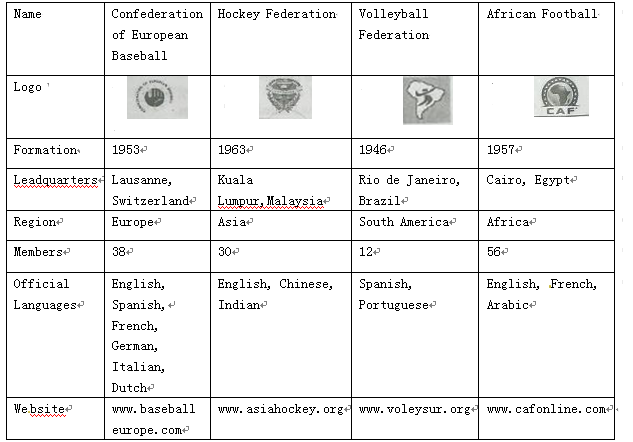
小題1: When was Asian Hockey Federation(亞洲曲棍球聯(lián)盟) set up?
A.In 1953B.In 1963
C.In 1946D.In 1957
小題2: Which organization has the most members?

小題3:In how many organizations can English be spoken as an official language?
A.OneB.Two
C.Three  D.Four
小題4: If you are from France, which sport can you probably take part in?
A.Baseball.B.Hockey
C.VolleyballD.Football
小題5: If you want to know something about volleyball, you can go to     .
A.www.baseballeurope.comB.www.asiahockey.org
C.www.voleysur.orgD.www.cafonline.com

查看答案和解析>>

科目: 來(lái)源:不詳 題型:閱讀理解

D
Graffiti is a common feature of most Western cities. The word graffiti was from the Greek word, graphein, which only meant writing. These days, however, the word means drawing or writing on the walls of buildings, or the public transportation, such as trains or buses.
Graffiti, as a form of expression, was born in New York during the 1960s and 1970s. At that time, a new modern culture about city life appeared. Graffiti was a written form of expression of that life. Later, it was mixed with a musical form called hip-hop that was another expression of the city life.
At first, graffiti artists used pens. But then, with the development of graffiti, they became experienced. They turned to using spray paint (噴漆罐). Spray paint allowed them to draw a greater area. And it also allowed them to work quickly.
At present, different people have different ideas about graffiti. Some people say it makes the cities dirty. It isn’t allowed by many local governments in America. The governments spend more than a million dollars a year cleaning graffiti. The money, they say, could be better spent on health or education. Other people think it is a form of art. In fact, the works of some famous graffiti artists can be found in museums, galleries, and art books.
小題1:Which is the present meaning of the underlined word “graffiti” now?
A.書法B.沙畫
C.涂鴉D.油畫
小題2:How many forms of expression of city life are mentioned in the second paragraph (段落)?
A.One.B.Two.
C.Three.D.Four.
小題3:Why did graffiti artists use spray paint?
A.Because they could work quickly.
B.Because they could spend less money.
C.Because they could paint a smaller area.
D.Because they could express themselves clearly.
小題4:What’s the article mainly about?
A.The meaning of graffiti.
B.Different expressions of graffiti.
C.Different attitudes (態(tài)度) towards graffiti.
D.The history and the development of graffiti.

查看答案和解析>>

科目: 來(lái)源:不詳 題型:完形填空

Language is colourful. There are many    with heart. One of them is to “l(fā)ose your heart” to someone. When that  , you have fallen in love.     if the person who “won your heart” does not love you, you are   to have a “broken heart.” In your    , you think that the person you loved is “hard-hearted,” and in fact, has a “heart of stone.”
You may decide to “pour out your heart” to a friend. Telling someone about your personal      can often make you feel better.
If your friend does not     to understand how painful your broken heart is, you may ask her to “have a heart.” You are asking your friend to show some sympathy (同情) for your    . Your friend “has her heart in the right place” if she says she is sorry for    you feel.
If your friend says, “My heart bleeds for you”, she means the     . She is a cold-hearted person who does not really      your situation.
When you are feeling    , “your heart is in your mouth.” You might say, for example, that your heart was in your mouth when you asked a bank to lend you some money to      a new house.
If that bank says    to you, do not “l(fā)ose heart.” Be “strong-hearted.” Sit down with the banker and have a “heart to heart” talk. Be open and honest about your situation. The bank may have a “change of heart” and agree to lend you the money. Then you could    worrying and “put your heart at rest.”
小題1:
A.a(chǎn)rticlesB.lettersC.expressionsD.words
小題2:
A.happensB.risesC.hasD.takes
小題3:
A.ThenB.AndC.ButD.So
小題4:
A.readyB.sureC.excitedD.surprised
小題5:
A.happinessB.sadnessC.kindnessD.sickness
小題6:
A.healthB.effortC.problemsD.honour
小題7:
A.needB.decideC.seemD.refuse
小題8:
A.situationB.locationC.directionD.lifestyle
小題9:
A.whatB.howC.whichD.when
小題10:
A.sameB.rightC.oppositeD.familiar
小題11:
A.care aboutB.care forC.look afterD.talk about
小題12:
A.a(chǎn)ngryB.sorryC.satisfiedD.a(chǎn)fraid
小題13:
A.look for B.pay forC.sell outD.clean up
小題14:
A.byeB.helloC.noD.thanks
小題15:
A.stopB.keepC.practiceD.continue

查看答案和解析>>

同步練習(xí)冊(cè)答案