
科目: 來源:黃岡題庫練考新課堂九年級 英語 題型:050
閱讀理解
“Climbing Mount Qomolangma is a kind of discovery,” said a reporter of CCTV. He was sent to join the climbing team for broadcasting this TV program. The climbers climbed Mount Qomolangma from May 18 to 24. CCTV also sent a team to join in this most dangerous and exciting sport. They called it “Standing at the World's Third Pole in 2003”.
It is just 50 years since the first climbers got to the top of Mount Qomolangma. In 2003, nearly 600 people from all over the world will try to reach the highest mountain in the world.
As we know, Mount Qomolangma is famous for its height——8 848 meters——in the world, so it has attracted thousands of people to climb. On May 25th, 1953, Edmund Hillary from New Zealand, and Tenzing Norway from Nepal finally reached the top of Mount Qomolangma. This most dangerous sport in the world brings the greatest challenge and the most exciting and happiest moment to human beings because the climbers have to. face the terrible cold and avalanches(雪崩), and some other difficulties. The higher they climb, the more difficulties they will meet. On the way to the top they may lose their lives at any time. It is reported that 175 climbers had to live there forever. During the past 50 years, more than 10000 men and women tried to get to the top, but only 1200 have made their dreams come true. We Chinese climbers first showed our national flag to the world on the top of the mountain in 1960.
Once someone asked why the pioneers never stopped trying to reach the top. “I don't think climbing the highest mountain only means danger or death. It is really a chance to challenge. You can really understand the love of nature and the true meaning of life,” a reporter of CCTV answered.
1.How many people succeeded in climbing up to the top of the mountain?
[ ]
2.What may the climbers meet when they climb Mount Qomolangma?
[ ]
A.Avalanches, rain, strong wind and the terrible cold.
B.Mist, strong wind, water and falling ice.
C.The terrible cold, avalanches, mist, strong wind and falling ice.
D.Rain, avalanches, mist, strong wind and falling ice.
3.When did the Chinese climbing team first stand on the top of Mount Qomolangma?
[ ]
4.What does the sentence “It is reported that 175 climbers had to live there for ever.” mean? It means ________.
[ ]
A.175 climbers had decided to live there
B.175 climbers didn't want to go back for ever
C.175 climbers climbed Mount Qomolangma
D.175 climbers lost their lives
5.What can we learn from the climbers?
[ ]
A.Their love of nature.
B.Their spirit of meeting the challenge bravely.
C.Their spirit of never giving up.
D.A, B and C.
查看答案和解析>>
科目: 來源:黃岡題庫練考新課堂九年級 英語 題型:050
閱讀理解
From age eight to eleven, I attended a small school in Bath, England. It was a small school of four classes with about twenty-five children in each class according to age. For the most part, one teacher had to teach all subjects to the children in the class. However, sometimes the headmaster, Mr Ronald Broaches, would come in and spend an hour or so, teaching some subjects in which he was especially interested. He was a large man with a very happy nature. He had a sense of humor and would delight in telling the children small stories that would make us laugh. He was a very fair man and had a great influence on many of the children. In my own case, I found that he took great interest in me and he quickly found that I enjoyed puzzles. He would often stop me as I was going to class and take a piece of paper out of his pocket, often with a puzzle already on it. The puzzles were usually mathematical or logical. As time went on, they slowly got more difficult, but I loved them. Not only that, they made me interested in math and problem solving that stays with me to this day. They also served to show me that intellectual activity was rewarding when the correct answers were found, but perhaps more importantly it was great fun. To this day, I can remember Mr Broaches' cheerful cry of “Well done!” whenever I got a problem right. The simple communication with a man whom I loved greatly has had a deep influence on my life. I shall forever be thankful that our paths crossed. Mr Broaches died just two weeks after I had won the 1993 Nobel Prize in Physiology or Medicine. Unluckily, I had no chance to speak to him before he died. I learnt later that he had heard of my success and I will always hope that he knew the deep influence 'he had made on my life.
1.There were ________ children in each class when Richard was in the school in Bath, England.
[ ]
2.From the text, we can learn that ________.
[ ]
A.the puzzles made the students laugh
B.the students were afraid of the headmaster
C.the puzzles made Richard enjoy math
D.the headmaster never taught in the school
3.The writer felt sorry because ________.
[ ]
A.Mr. Broaches had passed away before he won the Nobel Prize
B.he didn't express his thanks before Mr. Broaches died
C.he couldn't find Mr. Broaches after he grew up
D.Mr Broaches didn't know his success
4.What is the best title for the text?
[ ]
A.The Story of Mr Broaches
B.The Story of Richard J. Roberts
C.My Early School Life
D.An important teacher in my life
查看答案和解析>>
科目: 來源:黃岡題庫練考新課堂九年級 英語 題型:050
閱讀理解
Santa Fe, the capital of New Mexico, U. S. A., is in the central part of the state, on the Santa Fe River, which flows into the Rio Grande 35 kilometers west of the city. More than two thousand meters above sea level, it lies in the Sangre de Cristo Mountains with the Ortiz Mountains to the southeast.
Santa Fe was founded in 1609 by the Spanish on an old Indian village. In 1680 the Indians seized the place but only held it for twelve years before the Spanish retook it. The city remained under Spanish rule until Mexico won its independence in 1821. From then on it was a Mexican city until 1846 when it was taken over by American troops.
With a population of 48 953, Santa Fe is now the second largest city in the state. Because of its sunny weather, rich history and surrounding mountains, it is a good place for holiday makers. Besides hunting and skating in the mountains people enjoy shopping in the Indian and Spanish shops, which brings a large income to the city every year. In summer there is an international opera season when operas are shown in a partly-roofed, open-air theatre daily for people from all over the world.
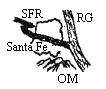
1.Which of the drawings below gives an idea of what Santa Fe is like?
RG=the Rio Grande SFR=the Santa Fe River OM=the Ortiz Mountains
[ ]


2.Santa Fe was under the rule of the Mexicans in ________.
[ ]
3.The people who held Santa Fe for the longest period in history were the ________.
[ ]
4.What is of special interest to people who visit Santa Fe in summer?
[ ]
5.Santa Fe is best described as a ________.
[ ]
6.One of the reasons for visitors to come to Santa Fe is that it ________.
[ ]
A.has fine weather
B.is the state capital
C.has historical monuments
D.is on the Santa Fe River
查看答案和解析>>
科目: 來源:黃岡題庫練考新課堂九年級 英語 題型:050
閱讀理解
The Great Fire of London started in the very early hours of 2 September 1666. In four days it destroyed more than three-quarters of the old city, where, most of the houses were wooden and close together. One hundred thousand people became homeless, but only a few lost their lives.
The fire started on Sunday morning in the house of the King's baker in Pudding Lane. The baker, with his wife and family, was able to get out through a window in the roof. A strong wind blew the fire from the bakery into a small hotel next door. Then it spread quickly into Thames Street. That was the beginning.
By eight o'clock three hundred houses were on fire. On Monday nearly a kilometer of the city was burning along the River Thames. Tuesday was the worst day. The fire destroyed many well-known buildings, old St Paul's and the Guildhall among them.
Samuel Pepys, the famous writer, wrote about the fire. People threw their things into the river. Many poor people stayed in their houses until the last moment. Birds fell out of the air because of the heat.
The fire stopped only when the King finally ordered people to destroy hundreds of buildings in the path of the fire. With nothing left to burn, the fire became weak and finally died out.
After the fire, Christopher Wren, the architect; wanted a city with wider streets and fine new houses of stone. In fact, the streets are still narrow; but he did build more than fifty churches, among them new St Paul's.
The fire caused great pain and loss, but after it London was a better place-a city for the future and not just of the past.
1.The fire began in ________.
[ ]
2.The underlined word “family” in the second paragraph means ________.
[ ]
3.It seems that the writer of the text was most sorry for the fact that ________.
[ ]
A.some people lost their lives
B.the birds in the sky were killed by the fire
C.many famous buildings were destroyed
D.the King's bakery was burned down
4.Why did the writer cite(引用) Samuel Pepys?
[ ]
A.Because Pepys was among those putting out the fire.
B.Because Pepys also wrote about the fire.
C.To show that poor people suffered most.
D.To give the reader a clearer picture of the fire.
5.How was the fire put out according to the text?
[ ]
A.The king and his soldiers came to help.
B.All the wooden houses in the city were destroyed.
C.People managed to get enough water from the river.
D.Houses standing in the direction of the fire were pulled down.
6.Which of the following were reasons for the rapid spread of the big fire?
(a) There was a strong wind.
(b) The streets were very narrow.
(c) Many houses were made of wood.
(d) There was not enough water in the city.
(e) People did not discover the fire earlier.
[ ]
查看答案和解析>>
科目: 來源:黃岡題庫練考新課堂九年級 英語 題型:050
閱讀理解
It is sometimes said that the English are polite people. This can make life difficult for foreigners. Suppose a foreign boy asks an English girl to go out with him and she says, “I finish my work, I'll meet you in the cafe at 7 o'clock.” Is she saying “yes” or “no” to his invitation?
In grammatical terms, she is using the conditional structure(表示條件的句子). By using the conditional, speakers of English can avoid giving a “yes” or “no” answer to a question. It enables people to be diplomatic(婉轉(zhuǎn)的). If the girl doesn't want to go out with the boy, she won't turn up at the cafe. She will let him understand she is still working, if she wants to go out with him, but doesn't want to appear too easy to catch, she has achieved that with her reply. But in this case, as she uses the first conditional which shows probability, she is quite likely to turn up at the cafe. Being polite can make life very difficult!
The conditional is often used by people in the news-politicians, for example-who wish to avoid speaking out their ideas. This is very important if they are on their way to discuss an agreement. No one wants to give away his or her points before he or she starts. A government spokesman might say to a group of workers, “If we could pay you more, we would.” The use of the conditional here makes room for argument although the speaker is using the second conditional form, which shows improbability. So it is unlikely the workers will get their rise.
“If” is a small word, which appears often in the English language. It can show politeness, reported speech and conditionals such as the First-probability-if I can come to your party, I will; the Second-improbability-if I saw you tomorrow, I'd give you the book; and the Third-impossibility (meaning it is too late to change something that has happened)-if you have told me, I would have helped you.
1.The using of the conditional can make a speech ________.
[ ]
2.Which of the following is true according to the passage?
[ ]
A.Language used in the news should make room to argue.
B.Usually English girls are not easy to catch.
C.English people never speak out their ideas in public.
D.The word “if” can show different meanings.
3.In the passage, “If we could pay you more, we would.” probably means “________.”
[ ]
A.the workers will make more money
B.the spokesman doesn't give any promise
C.the spokesman keeps his word
D.the workers' problems aren't difficult
4.This passage is mainly talking about ________.
[ ]
A.the conditional in communication
B.how to invite a girl in Britain
C.British people and their life
D.some language points in daily English
查看答案和解析>>
科目: 來源:黃岡題庫練考新課堂九年級 英語 題型:050
閱讀理解
All living things on the earth need other living things to live. Nothing lives alone. Most animals must live in a group, and even a plant grows close together with others of the same kind. Sometimes one living thing kills another, one eats and the other is eaten. Each kind of life eats another kind of life in order to live, and together they form a food chain. Some food chains are simple, while others are not. But all food chains begin with the sun, and all food chains become broken up if one of the links disappears.
All life needs sunlight to live on. But only plants can use sunlight directly. Plants are “factories”. They make food from sunlight, water and things in the soil and air.
Plants feed all other living things. Animals can only use the sun's energy after it has been changed into food by plants. Some animals feed directly on plants, others eat smaller animals. Meat-eating animals are only eating plants indirectly.
What about human beings? We are members of many food chains. We eat wheat, rice, vegetables, fruits and so on. We also eat meat and drink milk. But men often break up the food chains. They kill wild animals. They also make rivers, lakes and seas dirty. When these rivers, lakes and seas are polluted, the fish in them can not be eaten. If men eat the fish, they will get strange diseases.
Each form of life is linked to all others. Breaking the links puts all life in danger.
1.How does every living thing on the earth live?
[ ]
A.Each plant can live alone.
B.Each animal can live alone.
C.If living things want to live, they must kill each other.
D.Every living thing on the earth cannot live without others.
2.Which living things can use the sun's energy directly?
[ ]
A.Animals.
B.Plants.
C.Both, animals and plants.
D.All living things.
3.What do plants make food from? They make food from ________.
[ ]
A.sunlight, water and things in the soil and air
B.water, sunlight and things in the soil
C.water and things in the soil and air
D.water, sunlight and things in the soil
4.Who often break up the food chains?
[ ]
A.Human beings.
B.Animals.
C.Plants and animals.
D.Men and wild animals.
5.Which of the following do you think is the best title for this passage?
[ ]
查看答案和解析>>
科目: 來源:黃岡題庫練考新課堂九年級 英語 題型:050
閱讀理解
Happiness is for everyone. You don't need to care about those people who have beautiful houses with large gardens and swimming pools or those who have nice cars and a lot of money and so on. Why? Because those who have big houses may often feel lonely and those who have cars may want to walk on the country roads at their free time.
In fact, happiness is always around you if you put your heart into it. When you are in trouble at school, your friends will help you; when you study hard at your lessons, your parents are always taking good care of your life and your health; when you get success, your friends will say congratulations to you; when you do something wrong, people around you will help you to correct it. And when you do something good to others, you will feel happy, too. All these are your happiness. If you notice a bit of them, you can see that happiness is always around you.
Happiness is not the same as money. It is a feeling of your heart. When you are poor, you can also say you are very happy, because you have something else that can't be bought with money. When you meet with difficulties, you can say loudly you are very happy, because you have more chances to challenge yourself. So you cannot always say you are poor and you have bad luck. As the saying goes, life is like a revolving door. When it closes, it also opens. If you take every chance you get, you can be a happy and lucky person.
1.Those who have big houses may often feel ________.
[ ]
2.When you fall down in a PE class, both your teacher and your classmates will ________.
[ ]
3.What will your friends say to you when you make great progress?
[ ]
4.Which idea is NOT TRUE according to the passage?
[ ]
A.People who have cars would never like to walk in the open air.
B.You can get. help from others when you make mistakes.
C.You can still be a happy person even if you have little money.
D.Happiness is always around you though difficulties come towards you.
5.Which of the following is this passage about?
[ ]
查看答案和解析>>
科目: 來源:黃岡題庫練考新課堂九年級 英語 題型:050
閱讀理解
There were two McDonalds-Mac and Dick-and they were brothers. In 1948, they owned a restaurant in California. They liked working in the restaurant, but they got tired of the customers ordering so many different things to eat.
“If we gave customers a smaller menu, we could make some of the food before they came, and they wouldn't have to wait so long for their meals,” said one of the brothers. The other brother agreed and said, “And if we made the customers come to the counter, we wouldn't need any waiters or waitresses. We could also use plastic plates so there wouldn't be any washing-up.”
These were such good ideas that the McDonald brothers used them, and the customers were very pleased. They got their meals very quickly——in less than a minute——and they paid only 15 cents for hamburgers and 10 cents for fries. The first McDonald's restaurant had no seats for customers to sit on. This meant that people had to take their food away, and that no one had to clean up any tables after them.
Then a man called Ray kroc came to the brothers and asked to buy their business. They agreed to sell it to him for $ 27 million. After that, people paid Ray kroc to open their own restaurants using the McDonald's name and menu. Before long, there were McDonald's restaurants all over the United states, and nowadays, they are all over the world-even in China and Russia. The most successful McDonald's business is in Hong Kong of China. The Hong Kong McDonald's sells more hamburgers every day than any other McDonald's anywhere else in the world.
McDonald's restaurants are so successful because children love going to them. They like the food, and they like the toys and games they can get at McDonald's.
1.The McDonald brothers offered customers fewer kinds of foods so that ________.
[ ]
A.they didn't need waiters or waitresses
B.they could use plastic plates
C.customers would get their meals quickly
D.customers would pay less
2.Customers “paid only 15 cents for hamburgers” means the hamburgers were ________.
[ ]
3.The first McDonald's customers took their food away because ________.
[ ]
A.they wanted to eat it quickly
B.they did not want a large menu
C.there were no seats in the restaurant
D.they wanted to eat at home
4.Nowadays, the owners of McDonald's restaurants pay for ________.
[ ]
A.the McDonald's name and menu
B.children to play games
C.people to take the food away
D.customers to eat quickly
5.This story mainly tells us ________.
[ ]
A.a(chǎn) restaurant in California in 1948
B.how Ray kroc made money for the McDonald brothers
C.where McDonald's restaurants are in the world
D.how the McDonald's business started and grew
查看答案和解析>>
科目: 來源:黃岡題庫練考新課堂九年級 英語 題型:050
閱讀理解
Mr Smith was in trouble those days. He drove a car for Mr Black, a rich businessman. He worked hard and the shopkeeper liked him. But he couldn't work when he drank too much. And once he almost fell into the river when he drove along the bridge. Mr Black became angry and was going to send him away. He had a big family and was afraid of it and promised he would stop drinking at once. The man told him to wait to be dealt with.
One Monday morning Mr Smith came into the office with two badly burnt ears.
“What happened to your ears?” asked Mr Black.
“Well,” said the man. “I went to watch a football match yesterday while my wife was ironing clothes. She had put the iron near the telephone before she went to cook supper. Our team lost the game and I felt sorry for it. As soon as I went in the sitting-room, the phone rang and I answered the iron!”
“And what happened to the other ear?”
“When I put the iron down on the table, the telephone rang again!”
1.________, so he almost drove the car into the river.
[ ]
A.Mr Smith was not careful
B.Mr Smith drank too much
C.Mr Smith forgot they were on the bridge
D.Mr Smith couldn't work in the evening
2.Mr Smith went to watch the football match on ________.
[ ]
3.We can guess ________.
[ ]
A.Mr Smith drank much after the match
B.Mr Smith was angry with his team
C.Mr Smith didn't drink those days
D.Mr Smith watched the match at home
4.The ________ badly burned Mr Smith's ears.
[ ]
5.What would happen to Mr Smith?
[ ]
A.He would go on driving for Mr Black.
B.He would join his football team.
C.He would never watch any matches.
D.Mr Black would send him away.
查看答案和解析>>
科目: 來源:黃岡題庫練考新課堂九年級 英語 題型:050
閱讀理解
Billy is fourteen years old and in the ninth grade. He has a part-time job which gets him up every morning at five o'clock. He is a newspaper boy.
Each morning, Billy leaves the house at 5:15 to go to the comer where the newspapers are. The newspapers were delivered to the corner by truck at mid-night. He always takes a wagon to carry them.
In the winter it is still dark when he gets up, but during the rest of the year it is light. Billy must deliver the newspapers to the house of people on his route in all kinds of weather. He tried to put each paper on the porch where it will be protected from wind and rain or snow. His customers think that he does a good job. Sometimes they give him tips (extra money).
Billy earns about $ 5 per month, and he is saving some of the money to go to college. He spends the rest on records and clothes. Once a month, he has to collect money from his customers. Since many of them work during the day, Billy has to collect the money at night. Sometimes, when Billy is sick, his older brother has to deliver the newspaper. Once, Billy's father had to help.
Billy has seventy customers now, but he hopes to get more soon. Someday, if he gets many more customers, Billy might win a prize for being an outstanding newspaper boy. He wants to win a trip to Europe, but he will be happy if he wins a new bicycle.
1.Billy has to get up early for he has to ________.
[ ]
A.get the newspapers and deliver them to his customers
B.go to the corner to deliver the newspapers
C.collect money before the customers leave for work
D.go to the corner with his wagon
2.Sometimes the customers give him tips for ________.
[ ]
A.they-think he is an honest, good boy
B.they think he is doing his job well
C.they think he is good at his lessons
D.it is not easy for such a young boy to do the work
3.Billy is earning some money at young age, ________.
[ ]
A.which shows he comes from a poor family
B.for he has to support his big family
C.so as to save money to go on with higher education
D.so as to buy a bike of his own
4.When Billy fails to deliver the newspapers to his customers, ________.
[ ]
A.he won't be able to win the prize
B.his customers will not pay him money
C.his friend will come to help
D.his family will have to help
5.Billy hopes to win a prize ________.
[ ]
A.from his parents
B.from his customers
C.from a travel service
D.form the newspapers
查看答案和解析>>
國際學(xué)校優(yōu)選 - 練習(xí)冊列表 - 試題列表
湖北省互聯(lián)網(wǎng)違法和不良信息舉報平臺 | 網(wǎng)上有害信息舉報專區(qū) | 電信詐騙舉報專區(qū) | 涉歷史虛無主義有害信息舉報專區(qū) | 涉企侵權(quán)舉報專區(qū)
違法和不良信息舉報電話:027-86699610 舉報郵箱:58377363@163.com