
科目: 來源:人教新課標(biāo)初三上冊(cè)練習(xí) 人教新課標(biāo) 題型:050
閱讀理解
The children were talking about Christmas holidays in the classroom.
Jack, one of the boys, said that he went to Kansas with his friends. He told his classmates he saw something strange there.“When we were skating on a lake one day, one of us cut a hole in the ice, struck a match(擦火柴)and suddenly there was a fire right out of the hole for two or three minutes.”
“oh, no,”said all the others.“That couldn't be true. Water doesn't burn.”So they went to the teacher's office to see what she would say about this strange happening.
The teacher listened and said with a smile.“It seems that there is natural gas(天然氣) under the lake. The gas always goes up through the water. When the lake is frozen(結(jié)冰),the gas is caught under the ice. So when you cut a hole in the ice, the gas will come out and burn if you light it.”
(1) The children were talking about their ________ holidays.
[ ]
|
A. spring |
B. summer |
|
C. autumn |
D. winter |
(2) The fire burnt up out of a hole ______ .
[ ]
|
A. on a ground |
B. in the river |
|
C. in the sea |
D. in the ice |
(3) ________ saw the fire out of the hole.
[ ]
|
A. Jack |
B. Some girls |
|
C. The teacher |
D. All the children |
(4) The children went to ask the teacher because she ________.
[ ]
|
A. saw the fire |
B. had been there |
|
C. could help them |
D. knew everything. |
(5) The best title for this passage is ________.
[ ]
|
A. A hole in the ice |
B. Skating boys |
|
C. A strange fire |
D. Our teacher |
查看答案和解析>>
科目: 來源:人教新課標(biāo)初三上冊(cè)練習(xí) 人教新課標(biāo) 題型:050
閱讀理解
Mr. and Mrs. Smith had always spent their summer holidays in New Jersey(新澤西) in the past, staying in a small inn(旅店) at the foot of a hill.
One year, however, Mr. Smith made a lot of money in his business, so they decided to go to London and stay at a really good hotel while they went touring around that famous city.
They flew to London and arrived at their hotel late one evening. They had expected that they would have to go to bed hungry, because in that small inn in New Jersey, no meals were served after seven. They were surprised when the waiter asked whether they would take dinner there that night.“Are you still serving dinner?”asked Mr. Smith.“Yes, certainly, sir”, answered the waiter.“We serve it until half past nine.”
“What are the times of meals then?”asked Mr. Smith.“Well, sir”, answered the waiter.“We serve breakfast from seven to half past eleven in the morning, lunch from twelve to three in the afternoon, tea from four to five, and dinner from six to half past nine.”
“But that hardly leaves any time for us to see the sights of London.”said Mr. Smith.
(1) Mr. and Mrs. Smith had always spent their holidays in ________.
[ ]
|
A. New York |
B. London |
|
C. New Jersey |
D. Washington |
(2) When Mr. and Mrs. Smith had a lot of money, they decided to go to ________.
[ ]
|
A. their hometown |
B. the capital of England |
|
C. New Jersey |
D. a small city in England |
(3) They went to London by ________.
[ ]
|
A. sea |
B. plane |
|
C. train |
D. bus |
(4) From the story we know that this was the ________ time for Mr. and Mrs. Smith to go to London.
[ ]
|
A. first |
B. second |
|
C. third |
D. fourth |
(5) What does the sentence“But that hardly leaves any time for us to see the sights of London”mean?
[ ]
A. We can go to see the sights of London at any time.
B. We have enough time to see the sights of London.
C. We can see more sights of London.
D. We have little time to see the sights of London.
查看答案和解析>>
科目: 來源:人教新課標(biāo)初三上冊(cè)練習(xí) 人教新課標(biāo) 題型:050
閱讀理解
Ron is ten years old. He loves to watch TV. But for one full year, he did not watch TV at all. What was the reason? Ron's parents said they would give him $ 600 if he didn't watch TV for a year.
Ron's parents thought he watched too much TV. One day his mother saw a newspaper story about a boy who didn't watch TV for a year. She showed the story to Ron. Ron liked the idea. He turned off the TV right away, and said,“It doesn't bother me not to watch TV. I just want the money.”
At first, Ron's parents were very happy. Ron read books and newspapers, played outside, played computer games, and played cards with his mother. But after some time. he got bored (厭煩). Every evening, he asked his parents,“What are we doing tonight?”Sometimes his mother and father wished he would watch TV, just for one evening. Ron always said,“No, it would cost me money!”
Finally the year was over. Then Ron started watching his favorite TV shows all day long again. Ron got the money from his parents. What does he plan to do with the $600?“I want to buy myself a TV set!”he said.
(1) Ron didn't watch TV for one year because ________.
[ ]
A. he wanted the money
B. watching TV too much is bad
C. he wanted to study harder
D. he wanted to learn from the boy
(2)“It doesn't bother me not to watch TV”means“It's ________ to watch TV”.
[ ]
|
A. waste time |
B. important for me |
|
C. no use |
D. not important for me |
(3) Ron thought ________ for him to read and play all the time.
[ ]
A. it was great fun
B. it was no fun
C. it was enjoyable
D. it was good
(4) Ron's last words would ________ his parents.
[ ]
|
A. please |
B. frighten |
|
C. surprise |
D. excite |
(5) The best title for the story is ________.
[ ]
|
A. A Funny Story |
B. A year without TV |
|
C. A good Boy |
D. Buying a TV Set |
查看答案和解析>>
科目: 來源:人教新課標(biāo)初三上冊(cè)練習(xí) 人教新課標(biāo) 題型:050
閱讀理解
I was born in New York, but I grew up in Sam Francisco. I began to live in London 25 years ago. If I am asked now where I want to live forever, I would say London. But will always be American.
San Francisco, like London, has many parks. Every day my sisters and I were taken to play in the parks as children. I didn't go to school. I only had three hours of formal (正規(guī)的) education when five. I was sent to school but came home at noon on the first day. I said I didn't enjoy it and hadn't learned anything. My parents decided that school was not fit for me and I never went back.
My mother then taught me and my two sisters, in the way of an English lady who had good education. We learned languages and reading more than sciences and maths. Sometimes she taught us herself, but we also had other teachers. They asked us to take lessons every day. About once a week we walked to Golden Gate Park. While we were walking ,my mother taught me to read music. One day I noticed a little toy train in the window of a shop and I remember now how I'd like to have it. I couldn't say my“r”when I was small. My mother said if I could say an“r”well, I would have the toy train. I practised and practised. Then one morning I woke everybody up with my“r”s. I got the toy train. I usually get the things I want in life-but I work hard for them.
(1) The writer ________.
[ ]
A. was born in San Francisco
B. is living in New York now
C. likes living in London
D. doesn't like America
(2) The writer did not go to school in America because ________.
[ ]
A. his mother wanted him to go to school in England.
B. his parents did not think formal education was right for him.
C. his mother wanted him to play outdoors in the parks.
D. he couldn't get on well the other children
(3) Which of the following is TRUE?
[ ]
A. The writer was taught by his mother and other teachers.
B. The writer had no education at all.
C. The writer didn't have lessons every day.
D. The writer walked to the park to learn languages once a week
(4) The writer got the little toy train at last because ________.
[ ]
A. his mother gave him the money for it
B. he tried his best to read music
C. he wanted it very much
D. his mother was pleased with his progress
(5) The writer tells us ________.
[ ]
A. why children needn't go to school
B. how he grew up in San Francisco
C. that children liked toys
D. that his mother didn't give him any toys
查看答案和解析>>
科目: 來源:人教新課標(biāo)初三上冊(cè)練習(xí) 人教新課標(biāo) 題型:050
閱讀理解
Do you know why different animals or pests have their special colors? Colors in them seem to be used mainly to protect themselves.
Some birds like eating locusts, but birds can't easily catch them. Why? It is because locusts change their colors together with the change of the colors of crops. When crops are green, locusts look green. But as the harvest time comes, locusts change to the same brown color as crops have. Some other pests with different colors from plants are easily found and eaten by others. So they have to hide themselves for lives and appear only at night.
If you study the animal life, you'll find main use of coloring is to protect themselves. Bears, lions and other animals move quietly through forests. Hunters can't easily see them. This is because they have the colors much like the trees.
Have you ever noticed an even stranger act? A kind of fish in the sea can send out a kind of very black liquid when it faces danger. While the liquid spreads over, its enemies can't find it. And it immediately swims away. So it has lived up to now though it is not strong at all.
(1) From the passage we learn that locusts __________.
[ ]
A. are small animals
B. are easily found by birds
C. are dangerous to their enemies
D. change their colors to protect themselves
(2) How can pests with different colors from plants keep out of danger?
[ ]
A. They run away quickly.
B. They have the colors much like their enemies.
C. They hide themselves by day and appear at night.
D. They have to move quietly.
(3) Bears and lions can keep safe because__________.
[ ]
A. they have the colors much like the trees
B. they move quietly
C. they like brown and gray colors
D. they live in forests
(4) Why can the kind of fish live up to now? Because__________.
[ ]
A. it is very big and strong
B. the liquid it sends out can help it escape from its enemies
C. the liquid it sends out can kill its enemies
D. it swims faster than any other fish
(5) Which is the best title for this passage?
[ ]
A. The Change of Colors for Animals and Pests.
B. Colors of Different Animals and Pests.
C. The Main Use of Colors for Animals and Pests.
D. Some Animals and Pests.
查看答案和解析>>
科目: 來源:人教新課標(biāo)初三上冊(cè)練習(xí) 人教新課標(biāo) 題型:050
閱讀理解(根據(jù)短文內(nèi)容填空或簡要回答問題)
Here is a mark table about the students' English competition. Find some useful information to the following question.
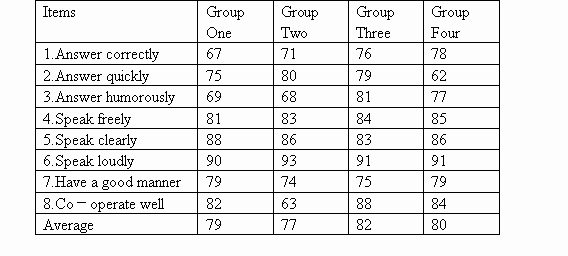
(1)__________ is the most humorous of all the four groups.
[ ]
(2) Group Two is thought to have spoken as __________ as Group Four.
[ ]
(3) Group Two did worst in“__________”.
[ ]
(4) In “Answer correctly”, Group Three got __________ more marks than Group One.
[ ]
(5) According to the table, which of the following is NOT true?
[ ]
A. Group Three is the winner of the competition.
B. Group One did as well as Group Four in “Answer quickly”.
C. All groups did best in “Speak loudly” of all the items.
D. The average of Group Two is 5 marks less than that of Group Three.
查看答案和解析>>
科目: 來源:人教新課標(biāo)初三上冊(cè)練習(xí) 人教新課標(biāo) 題型:050
閱讀理解
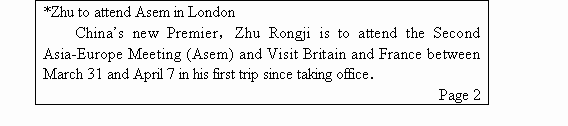


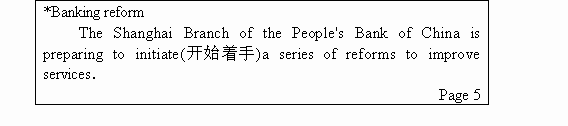


(1) The above section may possibly appear on _________. of China Daily.
[ ]
(2) From the headline we expect there will be _________ job chances for the laid-off workers in Beijing this year.
[ ]
(3) Premier Zhu will go to Europe to __________.
[ ]
A. attend Asem in Paris
B. visit Britain
C. have his first foreign trip
D. attend the meeting and pay an official visit to Britain and France well
(4) We can infer that Chinese language teaching in primary and secondary schools at present
[ ]
A. is satisfactory
B. meets the demands of the society
C. needs improvement
D. interests students
查看答案和解析>>
科目: 來源:人教新課標(biāo)初三上冊(cè)練習(xí) 人教新課標(biāo) 題型:050
閱讀理解
BEIJING(Xinhua)--Chinese have started to enjoy cars at low prices after the country became a member of the World Trade Organization (WTO). At the same time, competition between people has become stronger. According to the China's Ministry of Personnel(人事部), about 170 million people will lose their jobs after the country has joined the WTO.
However, many Chinese people living in other countries have come back home to face the challenges. So far ,about 130 thousand people have returned. These days, people, especially youths, have got to know the challenges of entry to the WTO. Books on the WTO have been hot selling. Some people are learning more about the WTO by going to night schools.
(1) This passage is probably ________.
[ ]
(2) According to the passage, how many people will lose their jobs after China has joined the WTO?
About________.
[ ]
(3)Who cares more about the challenges of entry to the WTO? __________.
[ ]
A. Old people.
B. Children.
C. Young people.
D. People from other countries.
(4)In this passage ,“hot selling” means __________.
[ ]
A. the books sell well
B. people buy the books on hot weather
C. the books sells at high price
D. people buy the books because they are new
(5) What's the main idea of this passage?
A. China has entered the WTO.
B. China meets the WTO challenges.
C. Many Chinese people have returned from foreign countries.
D. Some Chinese people are learning about the WTO by going to night schools.
查看答案和解析>>
科目: 來源:人教新課標(biāo)初三上冊(cè)練習(xí) 人教新課標(biāo) 題型:050
閱讀理解
In most parts of the world, many students help their schools make less pollution. They join “environment clubs”. In an environment club, people work together to make our environment clean.
Here are some things students often do:
No-garbage (垃圾) lunches. How much do you throw away after lunch? Environment clubs ask students to bring their lunches in bags that can be used again. Every week they will choose the classes that make the least garbage to the whole school!
No car day. On a no-car day, nobody comes to school in a car -- not the students and not the teachers! Cars give pollution to our air, so remember:
Walk, jump, bike or run.
Use your legs! It's lots of fun!
Turn off the water! Did you know that some toilets can waste twenty to forty m3 of water an hour? In a year, that would fill a small river! In environment clubs, students mend those broken toilets.
We love our environment. Let's work together to make it clean.
(1) Environment clubs ask students _________.
[ ]
A. to run to school every day
B. to take exercise every day
C. not to forget to take cars
D. not to throw away lunch bags
(2) From the passage we know the students usually have lunch________.
[ ]
(3) On a no-car day,_________ will take a car to school.
[ ]
A. both students and teachers
B. only students
C. neither students nor teachers
D. only teachers
(4) After students mend toilets, they save_________.
[ ]
(5) The writer wrote the passage to ask students to __________.
[ ]
A. clean schools
B. make less pollution
C. join clubs
D. help teachers
查看答案和解析>>
科目: 來源:人教新課標(biāo)初三上冊(cè)練習(xí) 人教新課標(biāo) 題型:050
閱讀理解
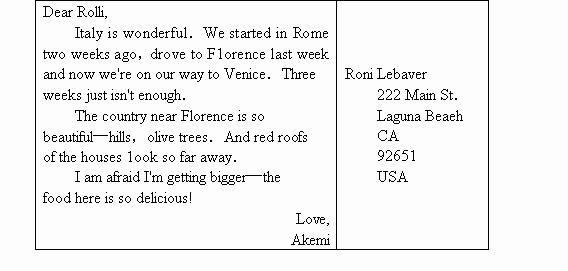
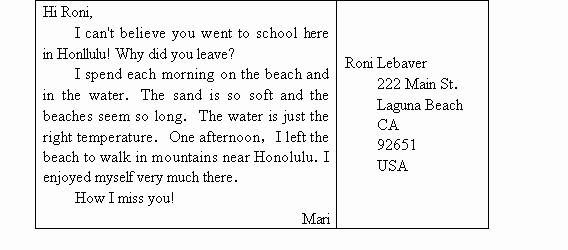
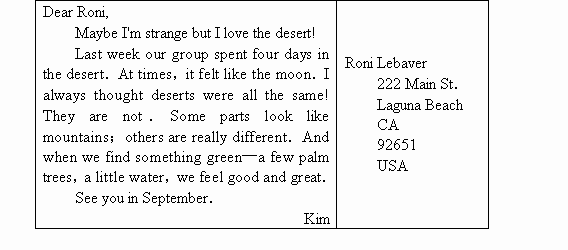
(1)Who seems to have too much?
[ ]
(2) Who went to school in Honolulu?
[ ]
(3) Who spent four days on the moon?
[ ]
(4) Where does Roni live?
[ ]
(5) Which of the sentences is true?
[ ]
A. Akemi arrived in Rome two weeks ago.
B. Marl spends every morning and afternoon on the beach.
C. Deserts always look the same.
D. Mari had a good time in Honolulu.
查看答案和解析>>
國際學(xué)校優(yōu)選 - 練習(xí)冊(cè)列表 - 試題列表
湖北省互聯(lián)網(wǎng)違法和不良信息舉報(bào)平臺(tái) | 網(wǎng)上有害信息舉報(bào)專區(qū) | 電信詐騙舉報(bào)專區(qū) | 涉歷史虛無主義有害信息舉報(bào)專區(qū) | 涉企侵權(quán)舉報(bào)專區(qū)
違法和不良信息舉報(bào)電話:027-86699610 舉報(bào)郵箱:58377363@163.com